Miller Trust Guide
Set up a Miller Trust before another month of Medicaid coverage is lost.
For adult children, spouses, and the attorneys, paralegals, and care managers who help them.
Most families get here the same way — a caseworker or hospital social worker just said the income is too high, and nobody explained what happens next.
The state already publishes the form. It just doesn't come with instructions — this does.
A Miller Trust (Qualified Income Trust, or QIT) is an irrevocable trust used in 24 US income-cap states to qualify a Medicaid applicant whose monthly income exceeds the long-term-care threshold (2026 cap: $2,982/month for a single applicant). Each state publishes its own QIT template on its Medicaid agency site. Our state-specific kit is the step-by-step playbook around that template — how to fund it, how to open the bank account when the branch refuses, how to redirect Social Security and pension, and how to avoid the denial reasons most families trip on. $97, instant download, money-back if the agency rejects the trust. We are researchers, not attorneys.
Pick your state to start
Don't see your state? If you're in New York, we don't publish a Miller Trust kit there — New York doesn't offer that mechanism at all. See our New York Pooled Income Trust guide instead, the tool New York uses in its place.
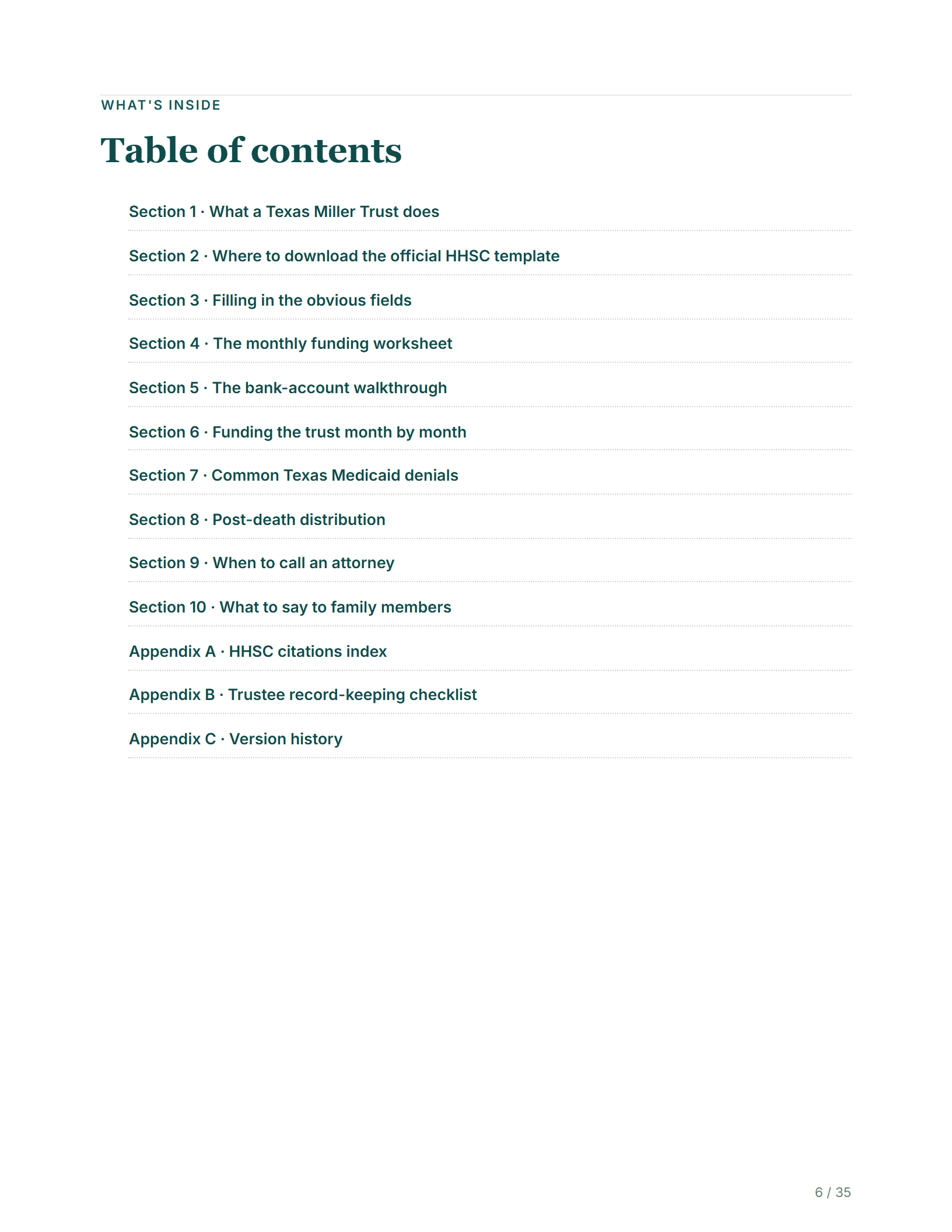
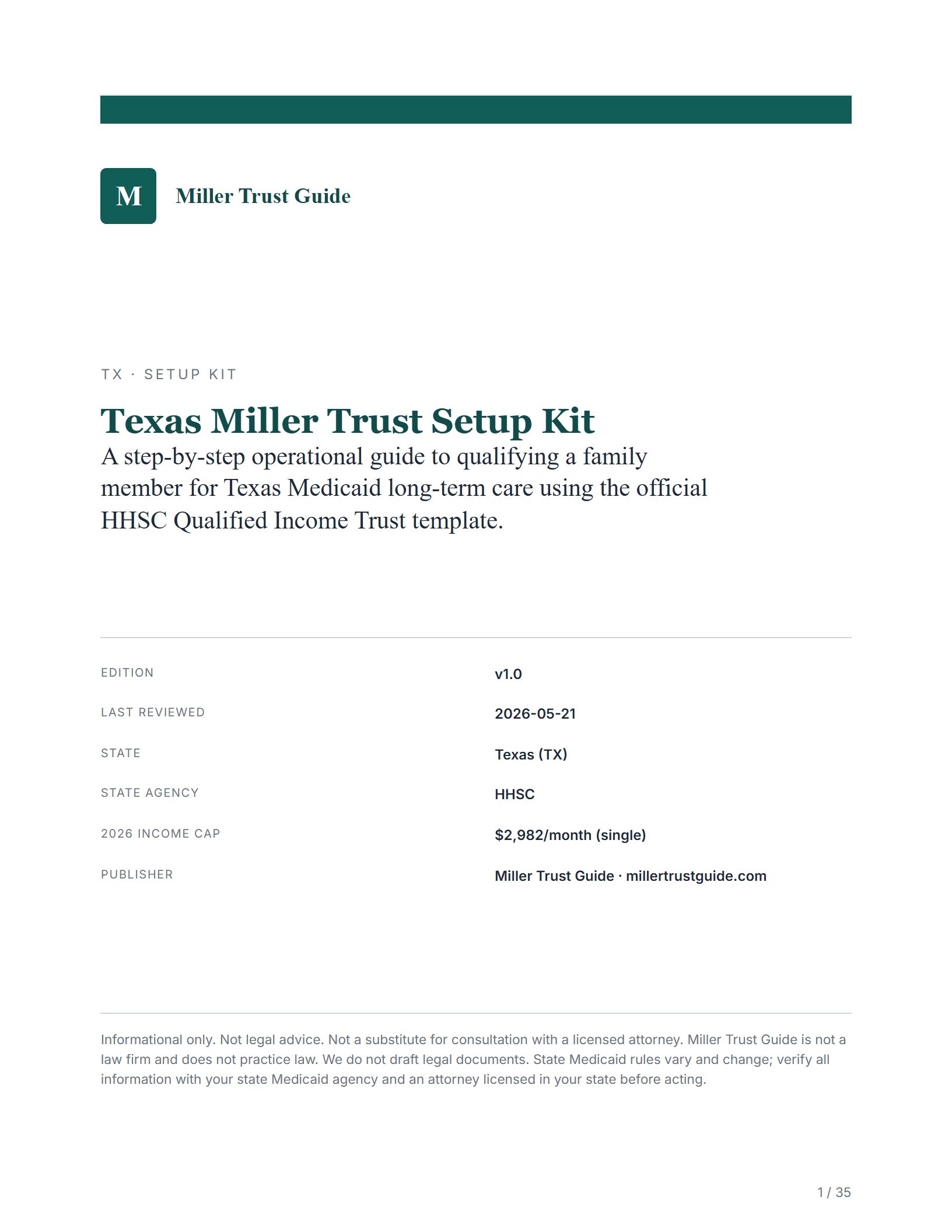
What you get A printable PDF built around your state's own Medicaid rules. Shown: the cover and contents of the Texas kit.
- Available now
- Doesn't apply
60-second check
Do you even need a Miller Trust?
Most states use the same 2026 long-term-care Medicaid income cap ($2,982 per applicant) — but a couple of states differ, and if both spouses are applying, each one's income is tested separately against this same cap. Pick your state below for the exact figure, or check the general estimate.
Not sure how to total income, or have an unusual situation? See the state guides or read what we do and don't help with. This check runs entirely in your browser — nothing you type is sent or saved. Informational, not legal advice.
What buyers say
Real, verified, and shown here because it's genuine — not a stock quote, not written by us. We only publish testimonials from actual buyers who gave permission.
Your Setup Kit turned out to be extremely useful. It got us to the New Jersey QIT template right away, and that was big. We used the Kit to work through the template and the practical questions about how a QIT actually works, and we were able to draft it, get it executed, open a bank account, and submit it with the application in just two or three days. It was an essential need for us, and the Kit helped us accomplish it very quickly.
What this is — and what it isn't
- An informational operational guide. Plain-English explanations of state Medicaid policy, citations, and step-by-step instructions.
- Not legal advice. Not a substitute for a licensed attorney. We do not draft trust instruments.
- Not personalized. Every buyer in a given state receives the byte-identical kit.
- Support is email-only and limited to product and refund questions. For advice on your specific situation, consult a licensed elder-law attorney in your state.
Frequently asked questions
How fast do I get the kit and start the trust?
What does the kit cost and what's the guarantee?
When does Medicaid coverage actually begin?
Why not just hire an elder-law attorney?
What is a Miller Trust?
Is a Miller Trust the same thing as a Medicaid Asset Protection Trust?
What is the 2026 Medicaid income limit?
Which states allow Miller Trusts?
Do you draft the trust document?
Is this legal advice?
The mistakes that cost families a month of Medicaid coverage
5 short, plain-English emails over 3 weeks — the funding-month rule, what really happens at the bank, why most denials are paperwork not eligibility, the trustee's actual monthly workload, and the one honest sign it's time to call an attorney instead. Then we stop. No ongoing newsletter, no sales list.
Or explore the map
States in teal have a live guide — click one to open it. Gray states don't use this mechanism at all.
- Available now
- Doesn't apply
Browse every state guide
Every state guide includes the bank-refusal script, a monthly funding worksheet and a denial-avoidance checklist. Instant download, money-back if your state's agency rejects the trust.
- Alabama Qualifying Income Trust Kit $97
Kit · official Alabama Medicaid template
- Alaska Qualifying Income Trust Guide $97
Guide · DPA's published requirements
- Arizona Income-Only Trust Guide $97
Guide · AHCCCS's published requirements
- Arkansas Income Trust Kit $97
Kit · official Arkansas DHS template
- Colorado Income Trust Kit $97
Kit · official HCPF template
- Delaware Miller Trust Guide $97
Guide · DHSS/DMMA's published requirements
- Florida Qualified Income Trust Guide $97
Guide · DCF's published requirements
- Georgia Qualified Income Trust Kit $97
Kit · official DCH template
- Idaho Income Trust Guide $97
Guide · IDHW's published requirements
- Indiana Miller Trust Kit $97
Kit · official FSSA template
- Iowa Medical Assistance Income Trust Guide $97
Guide · Iowa HHS's published requirements
- Kentucky Qualifying Income Trust Guide $97
Guide · DMS's published requirements
- Mississippi Income Trust Kit $97
Kit · official Mississippi Medicaid template
- Missouri Qualified Income Trust Kit $97
Kit · official Missouri FSD template
- Nevada Qualified Income Trust Guide $97
Guide · DSS's published requirements
- New Jersey Qualified Income Trust Kit $97
Kit · official DMAHS template
- New Mexico Income Diversion Trust Guide $97
Guide · HCA's published requirements
- Ohio Miller Trust Kit $97
Kit · official ODM template
- Oklahoma Medicaid Income Pension Trust Guide $97
Guide · OHCA's published requirements
- Oregon Income Cap Trust Guide $97
Guide · ODHS APD's published requirements
- South Carolina Income Trust Kit $97
Kit · official SCDHHS template
- South Dakota Medicaid Income Trust Guide $97
Guide · DSS's published requirements
- Tennessee Qualified Income Trust Guide $97
Guide · TennCare's published requirements
- Texas Miller Trust Kit $97
Kit · official HHSC template
- Wyoming Income Trust Guide $97
Guide · WDH's published requirements
Don't see your state? If you're in New York, we don't publish a Miller Trust kit there — New York doesn't offer that mechanism at all. See our New York Pooled Income Trust guide instead, the tool New York uses in its place.
Every claim on this site cites a primary state agency document or a recognized source — see our full citation list and editorial process →. Also: What Is a Miller Trust? (the complete guide) → · How to Set Up a Miller Trust → · Medicaid Asset Protection Trust guide → · Medicaid Estate Recovery guide → · Pooled Income Trust guides → · About the author →