Arkansas Income Trust Setup Guide — Qualify a Family Member for Medicaid Before the Next Billing Cycle
For adult children, spouses, and the attorneys, paralegals, and care managers who help them — before another $7,148–$7,711 month of private-pay care goes by.
An Arkansas Income Trust (also called a Miller Trust or Qualified Income Trust) is an irrevocable trust used to qualify a Medicaid applicant whose monthly income exceeds the Arkansas long-term-care income cap of $2,982 per month (CMS January 2026 figures). The trust must be drafted, signed, and funded in the same calendar month using the official Arkansas DHS template (Arkansas Medical Services Policy Manual, Section H — Long-Term Services and Supports, §H-110 through §H-116 (Income Trusts)). Medicaid eligibility can't start before the month the trust is funded (the trust can't be back-dated), and every month of delay is another month of full private-pay nursing-home cost ($7,148–$7,711/mo in Arkansas). This guide is the step-by-step operational walkthrough most families need: $97, instant download, money-back if Arkansas DHS rejects the QIT for a reason traceable to following the kit.
It applies when the person who needs care has gross monthly income over Arkansas's income cap of $2,982, whether you're their child, their spouse, or a professional helping them.
Spouse staying at home?
Only the applicant's own income counts toward this cap, not yours. Separate federal protections keep you from being left without enough to live on: a resource allowance and, when your own income is low, a monthly income allowance. See Medicaid spousal impoverishment protection.
The step-by-step playbook most Arkansas families need to fund a Qualified Income Trust without paying $1,000–$2,500 for an attorney to do what is, in practice, a few hours of paperwork and one trip to the bank. Built directly around the official Arkansas DHS template. Informational only — not legal advice. But it isn't guesswork: every step is drawn straight from Arkansas DHS's own published policy, with the citation behind each claim.
What usually happens
You find the free Arkansas DHS form, and it looks simple. Then an elder-law attorney quotes $1,000–$2,500 to handle it. So you fill it in yourself, get it signed, and take it to the bank, where the branch has never opened one of these and says no. Meanwhile the month is running out. Coverage can't start before the month the trust is funded, so a month that slips is another $7,148–$7,711 of private-pay care. (Source for the funding rule: Arkansas DHS, Arkansas Medical Services Policy Manual, Section H — Long-Term Services and Supports, §H-110 through §H-116 (Income Trusts).)
The legal document is Arkansas DHS's own form. What it leaves out is the order of operations: what the bank will ask for before you walk in, and funding the trust before the month closes. Arkansas is different: its form has the trustee file the trust's own tax return, so the account is generally opened with a separate tax ID (an EIN, free from the IRS online). The kit covers the rest: a word-for-word reply for each bank refusal and a printable letter for the branch manager, a funding worksheet built on the 2026 Arkansas income cap, and the 9 reasons Arkansas DHS most often denies these, each cited to Arkansas DHS's own policy.
You stay in control: you open the account at your own bank, and we never see or touch a dollar of your family's income. Money-back if Arkansas DHS rejects it, or for any reason within 7 days.
Questions about the kit before you buy? Email support@millertrustguide.com.
- Built on Arkansas DHS's own .gov template
- Every claim cited to Arkansas DHS policy
- Last verified against Arkansas DHS on September 9, 2026
- We never collect your family member's details
- Secure checkout by Stripe
- Money-back if the trust is rejected
What buyers say
A review from a different state — because it's real, and we'd rather show a genuine reader than fill this page with something invented. Retired attorney & CPA is exactly the kind of reader who'd catch it if this guide were sloppy, which is why we lead with it. We only publish verified customers who gave permission — no invented reviews, no stock quotes.
Your Setup Kit turned out to be extremely useful. It got us to the New Jersey QIT template right away, and that was big. We used the Kit to work through the template and the practical questions about how a QIT actually works, and we were able to draft it, get it executed, open a bank account, and submit it with the application in just two or three days. It was an essential need for us, and the Kit helped us accomplish it very quickly.
Not the only one deciding? Send them this page before you dive in.
$7,148–$7,711 a month, Arkansas private-pay care
Why this can't wait: until the trust is set up correctly, an over-income applicant can't be approved for Medicaid — so the private-pay bill keeps landing on your family, and your family member's place in care can depend on it. Coverage begins the calendar month the QIT is signed and funded — there is no back-dating — and Arkansas private-pay care runs $7,148–$7,711 a month, so every 30 days of delay is another full month of private-pay bills out of pocket.
The 2026 Arkansas income cap
- Income cap, single applicant
- $2,982/mo
- Personal needs allowance
- $40/mo
- Arkansas private-pay care
- $7,148–7,711/mo
Setting up a Miller Trust in Arkansas starts with one number — the income cap. The Arkansas 2026 Medicaid long-term-care income limit is $2,982/month for a single applicant. If your family member's countable monthly income exceeds this limit, a properly drafted, signed, and funded QIT diverts the excess and brings countable income below the cap. The applicant's Personal Needs Allowance in Arkansas is $40/month. Source: Arkansas DHS Arkansas Medical Services Policy Manual, Section H — Long-Term Services and Supports, §H-110 through §H-116 (Income Trusts) [1].
What's in the Arkansas kit
10 operational sections and 3 reference appendices. Here are the six pieces buyers tell other buyers made the difference:
“Isn't the QIT form free from Arkansas DHS?”
It is — and the kit links you straight to it, at no charge. You're not paying for the form. You're paying for the part that actually trips families up: the same-calendar-month funding rule, the word-for-word bank-refusal script, and the 9 Arkansas DHS denial traps with the policy citation behind each. The form is a couple of pages; getting it accepted is where a month of coverage gets lost.
If your spouse is the one entering care: this kit covers the Qualified Income Trust — the income side of qualifying — in full. If you're the spouse staying at home (the "community spouse"), the kit also walks you through the trust itself, and Section 9 orients you on the separate resource-allowance rules that protect your home and savings. Those resource rules are fact-specific, so for them you'll likely still want an Arkansas elder-law attorney — but the kit's job is to make that a short, cheaper meeting instead of a $1,000–$2,500 one: you walk in with the trust already set up, the resource questions already identified, and the documents already gathered, so you're paying for answers, not for someone to explain the basics to you.
Before you buy
Who this kit isn't for
We'd rather you not buy something you don't need. Skip it if:
- The income is at or under $2,982/month. A Income Trust usually isn't needed. Check the number with the free income-cap check.
- The obstacle is savings or property, not income. A Income Trust only deals with income. See Medicaid asset protection trusts for the asset side.
- Money or property was given away in the last five years, or other trusts are involved. That needs an Arkansas elder-law attorney.
- You want someone to fill it in and file it for you. That's what an attorney does. This kit is for doing it yourself, or for checking someone else's work.
How it works in Arkansas
- Confirm income is over the $2,982 cap Gross monthly income, from every source.
- Fill in the official Arkansas DHS template The state's own form, free from Arkansas DHS.
- Name a trustee and open the trust account A dedicated bank account titled to the trust.
- Fund it in the same calendar month Eligibility starts that month, never earlier.
Full step-by-step walkthrough →
The funding-month rule
- September Trust not funded Private pay: $7,148–$7,711 for the month.
- October Sign, open, deposit Trust signed, account opened and income deposited, all this month. Eligible from October.
- November onward Deposit every month The income goes into the trust account every month to keep eligibility.
There is no back-dating. Funding in October can't cover September.
What it actually looks like
Sample pages from the kit
Real pages from the Arkansas kit PDF. Click any page to enlarge.
-
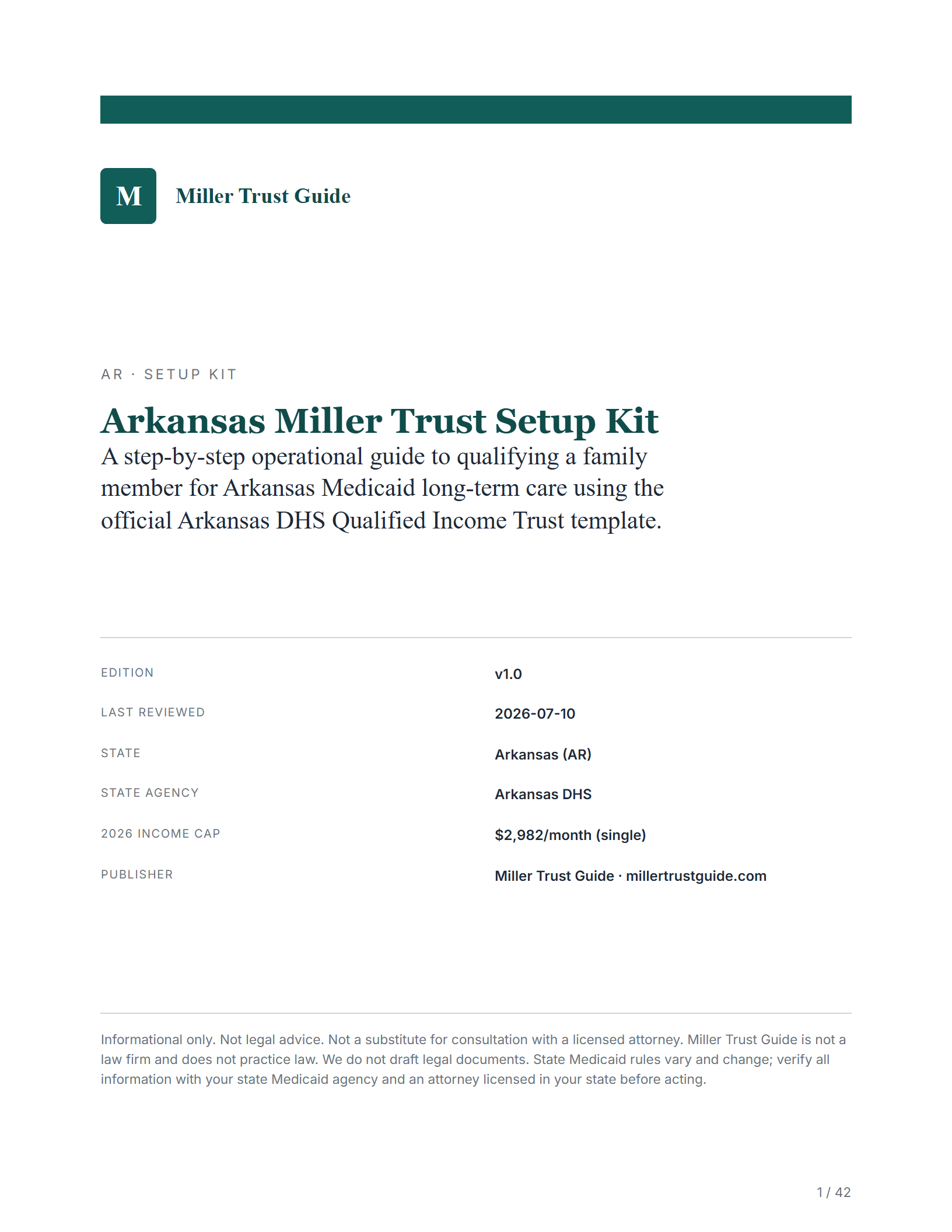
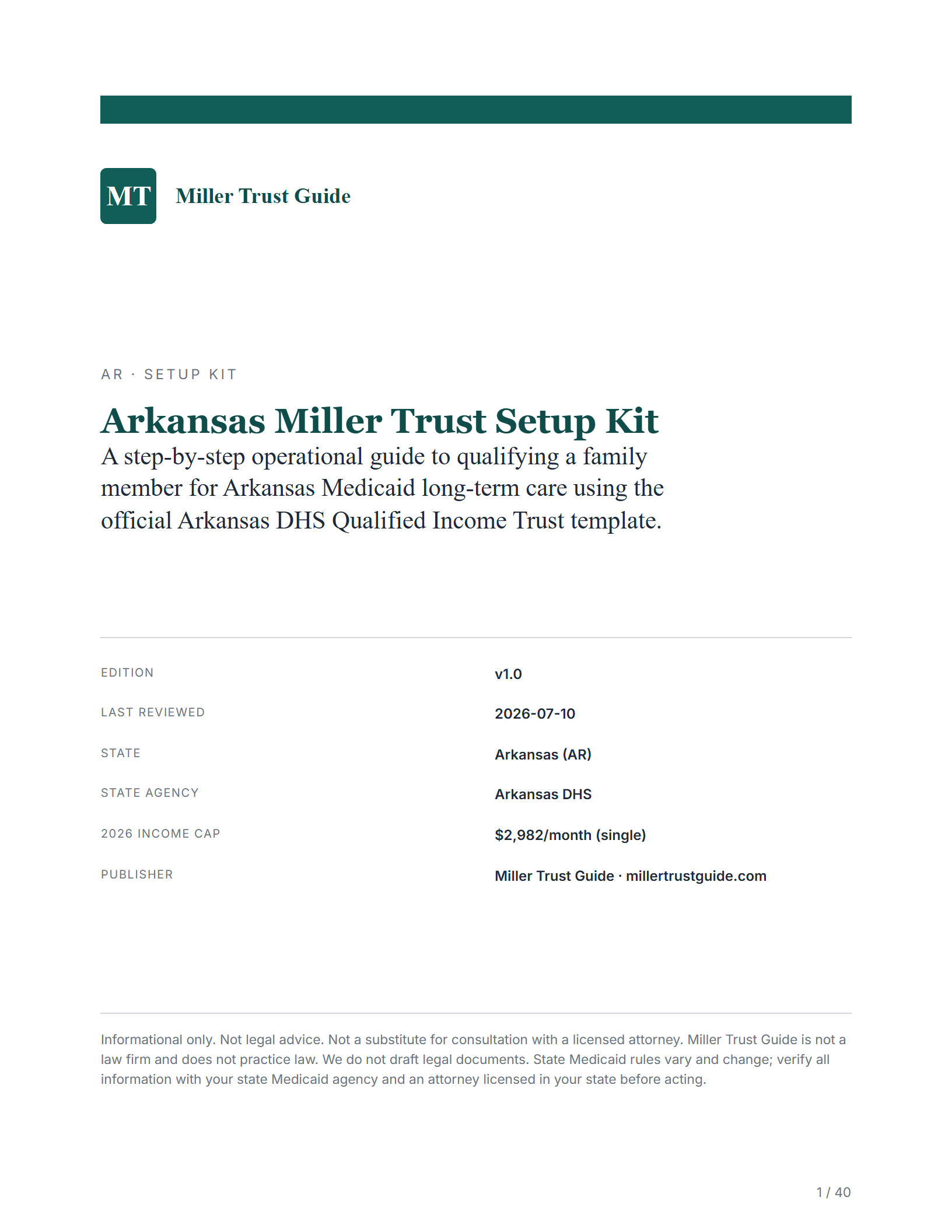
Cover & key facts
Version, last-reviewed date, the 2026 income cap, and the disclaimer — all on page 1.
View page -
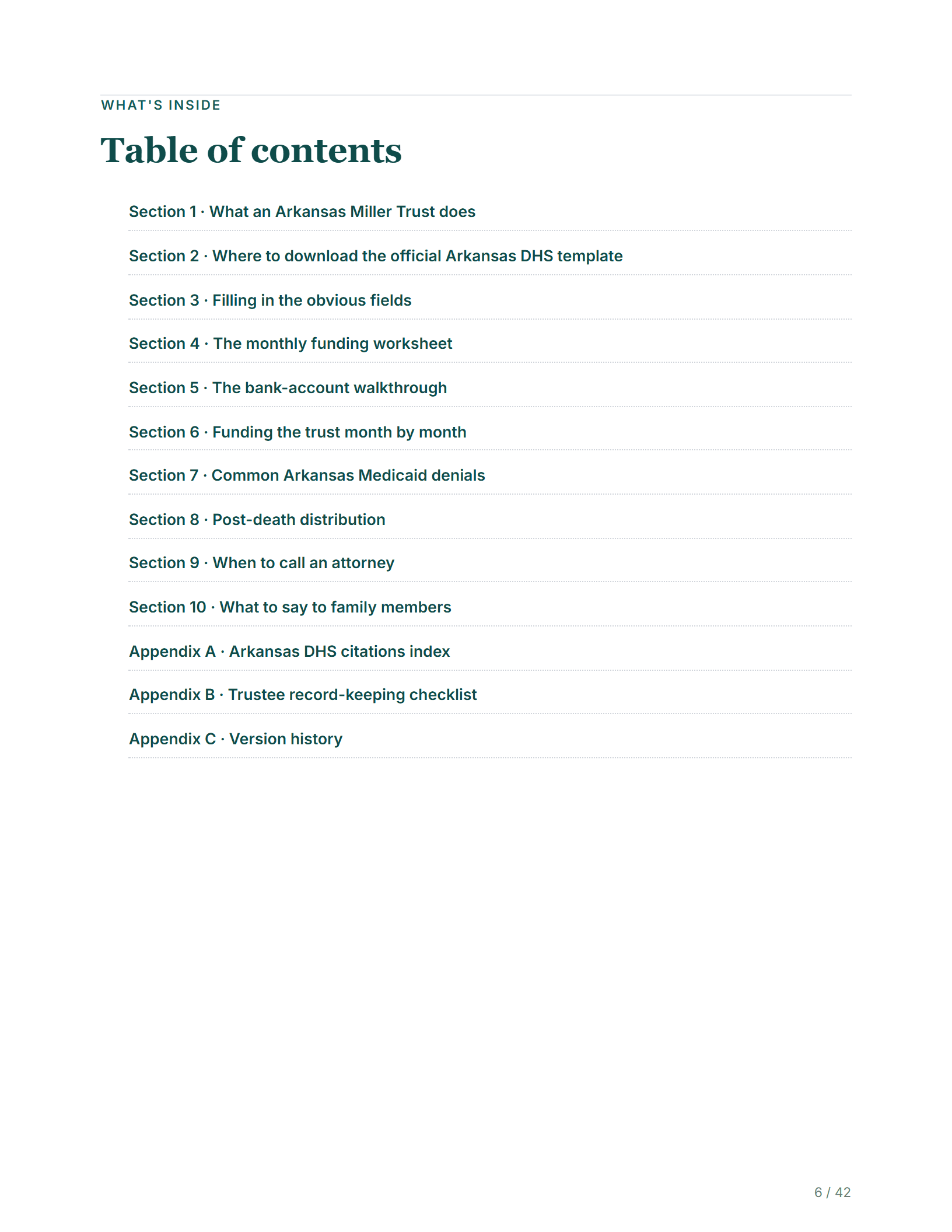
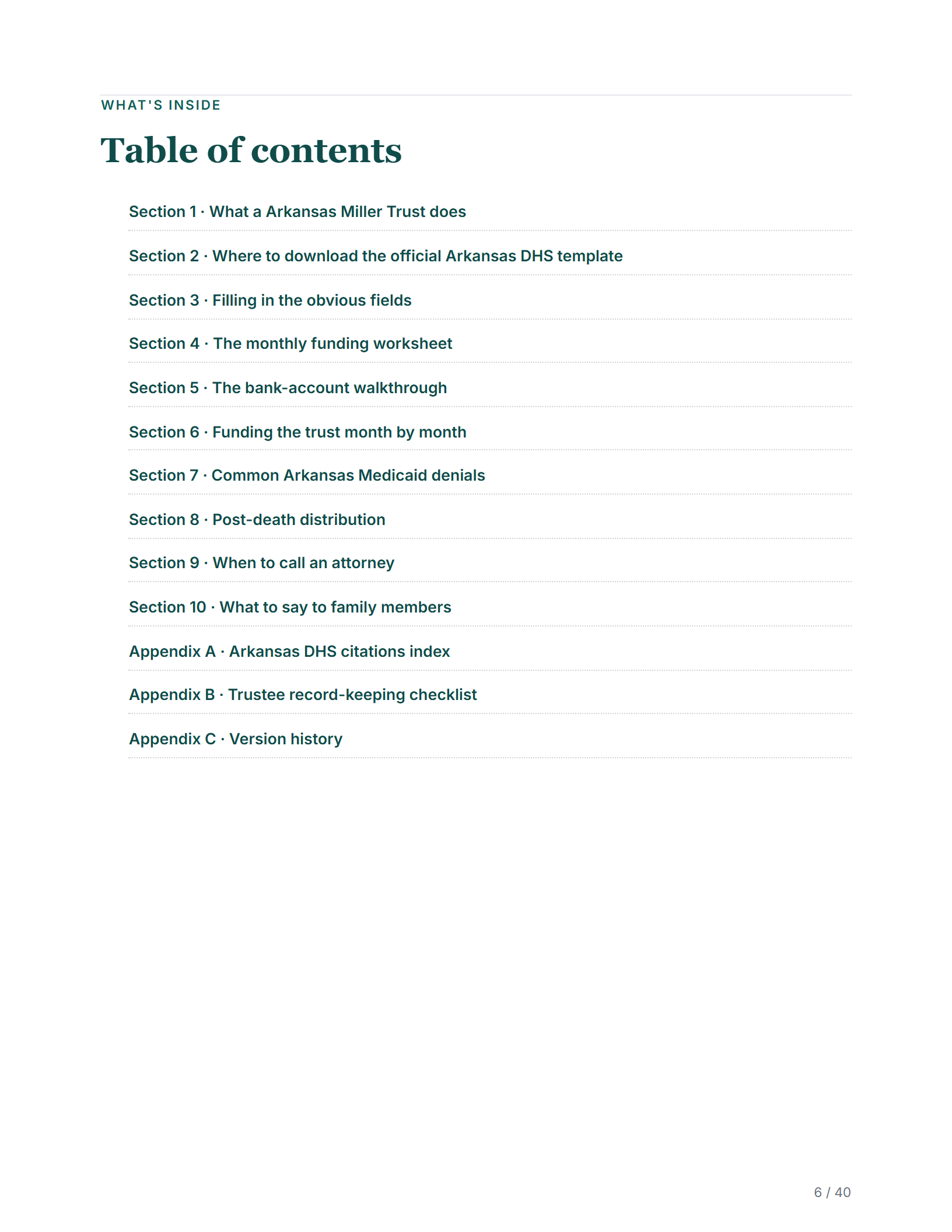
Table of contents
Ten operational sections plus three reference appendices. Every section in the order you'll use it.
View page -
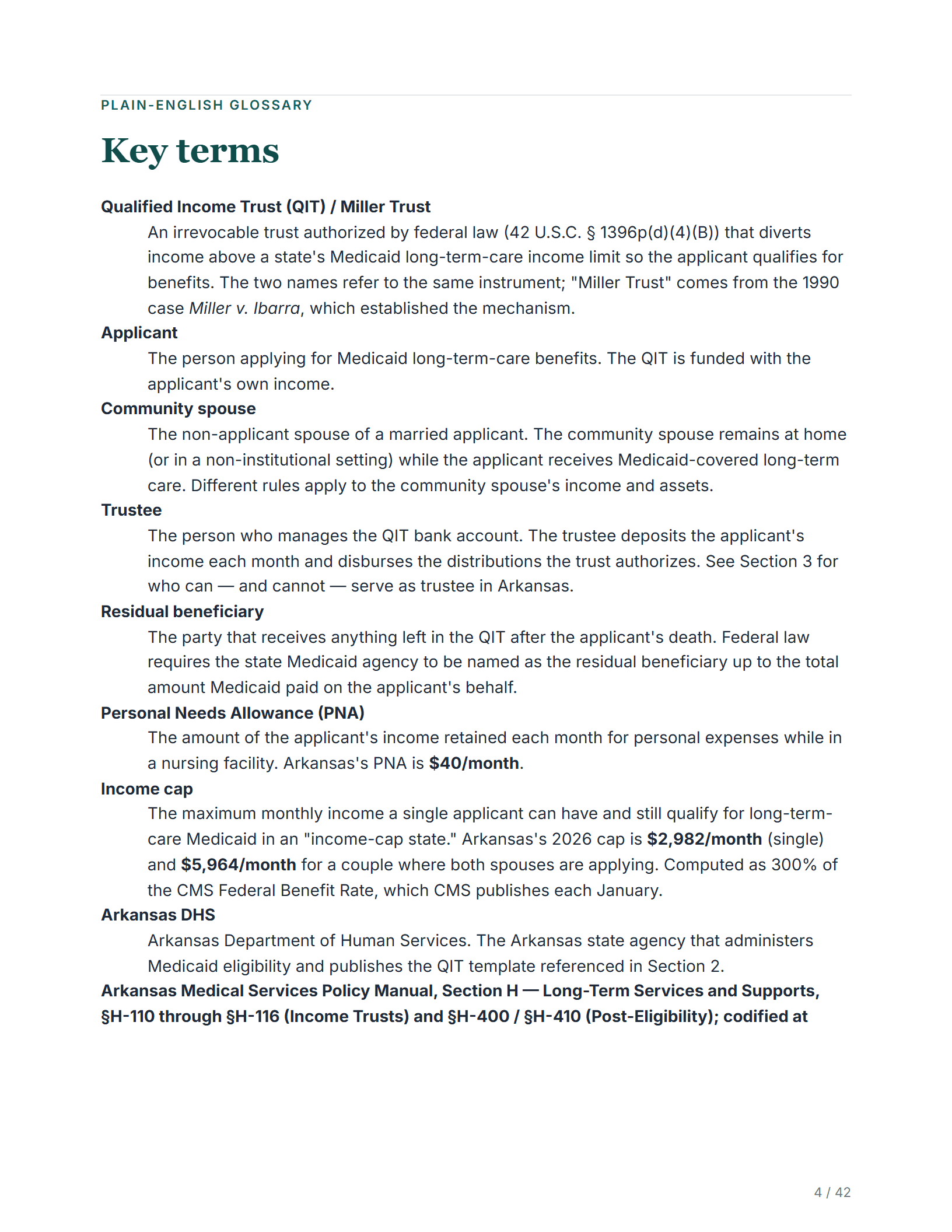
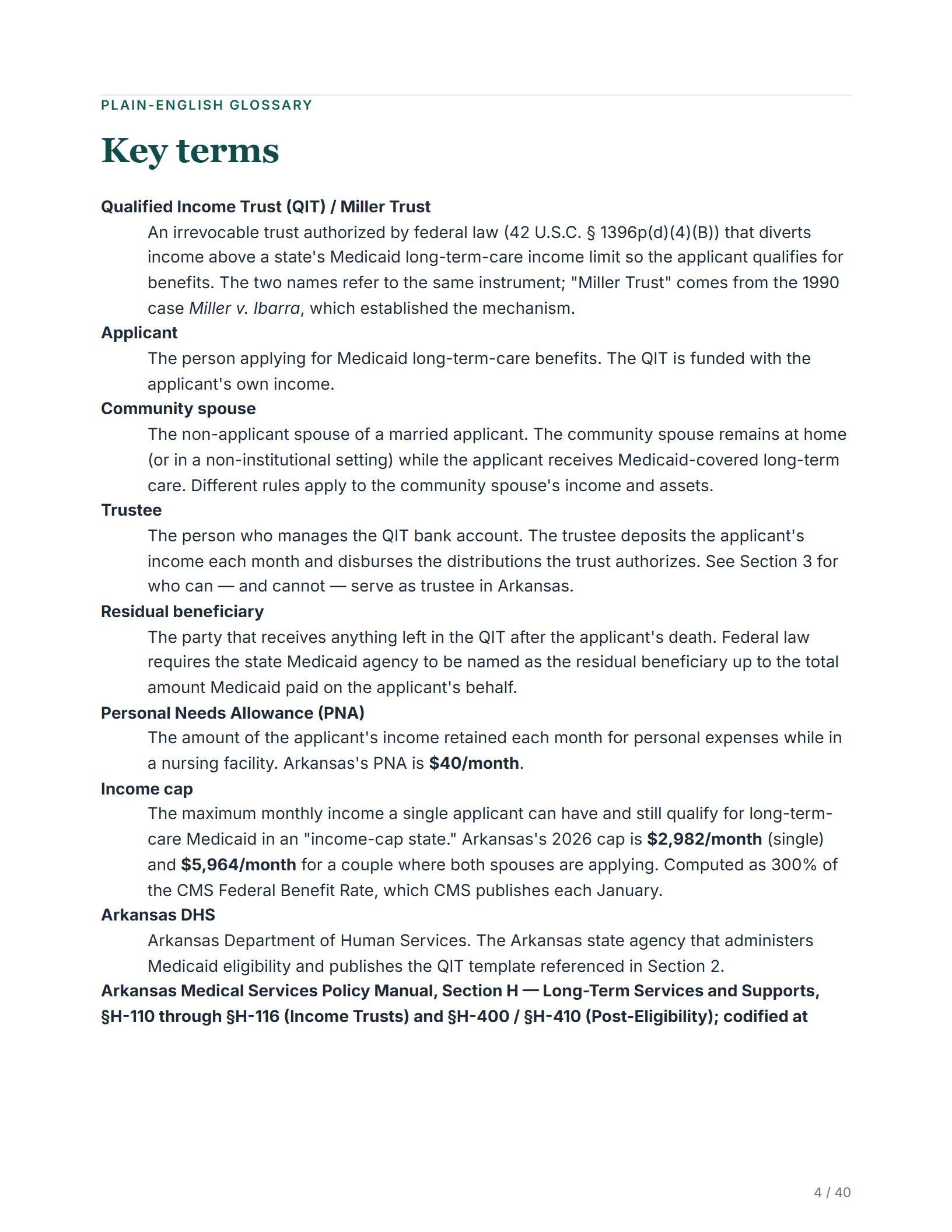
Plain-English glossary
Eleven key terms translated for a non-attorney reader. The vocabulary the rest of the kit assumes.
View page -
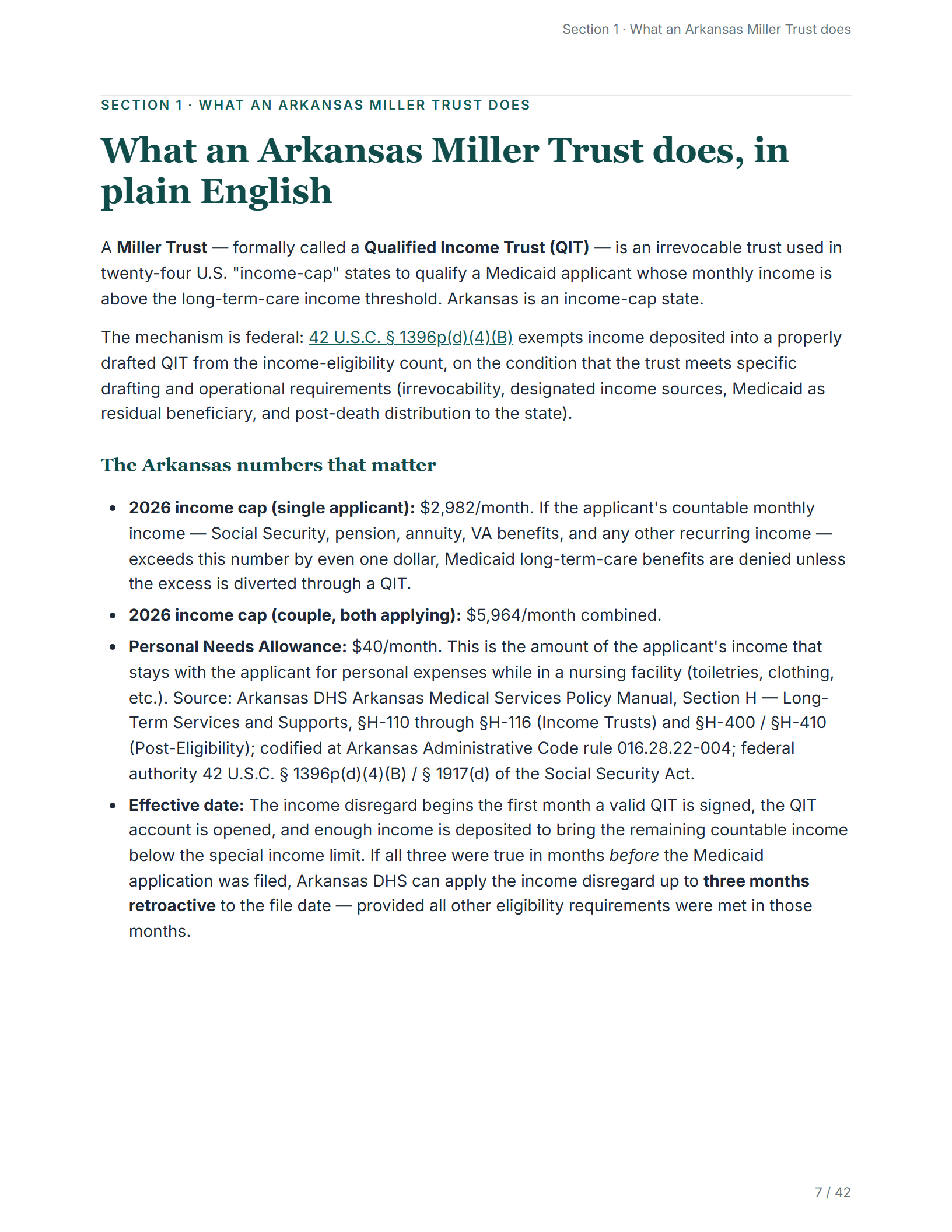
What it does, in plain English
The mechanism explained in plain language, cited to the federal statute, with your state's exact income cap and Personal Needs Allowance built in.
View page -
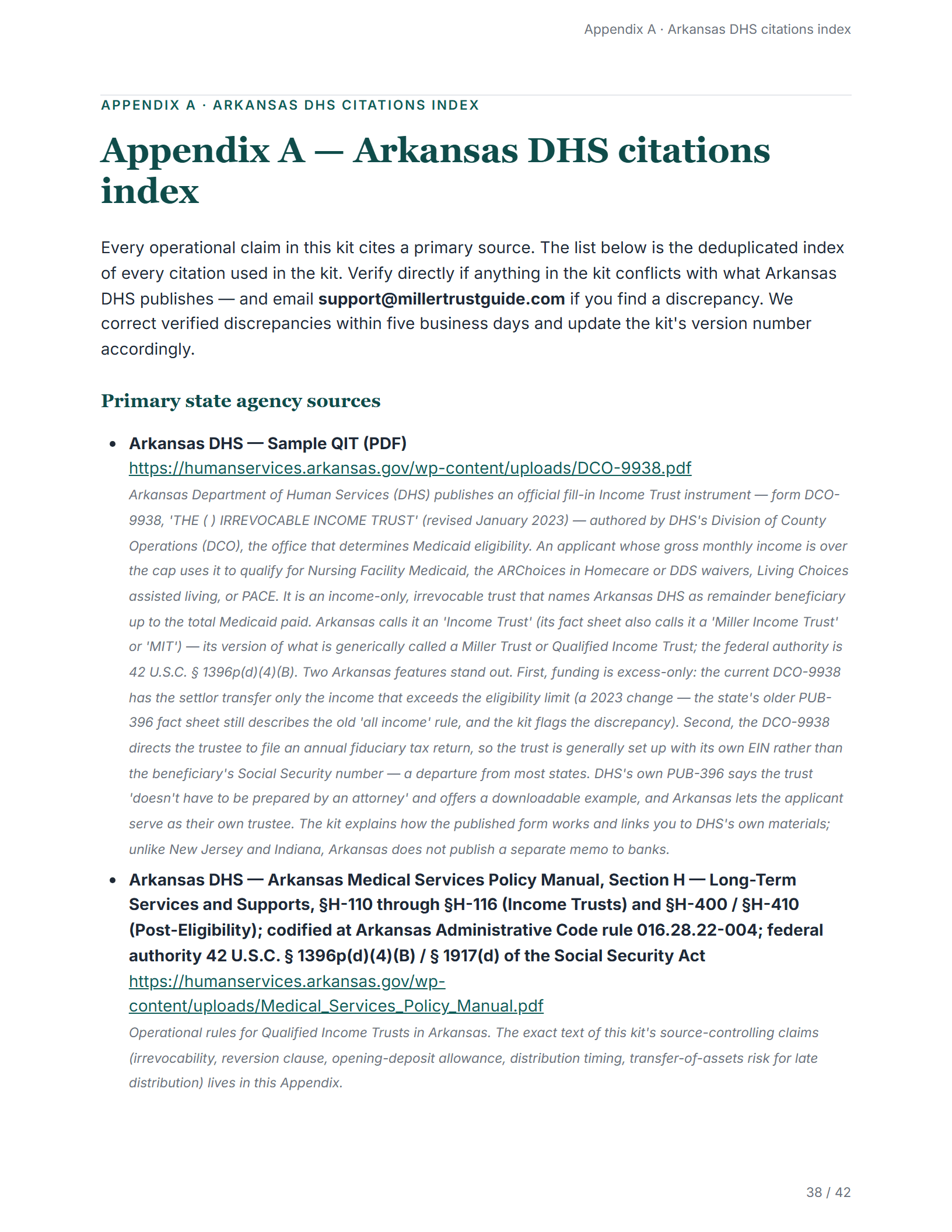
Citations index
Every operational claim sourced to a primary state-agency, CMS, SSA, or federal-statute citation.
View page
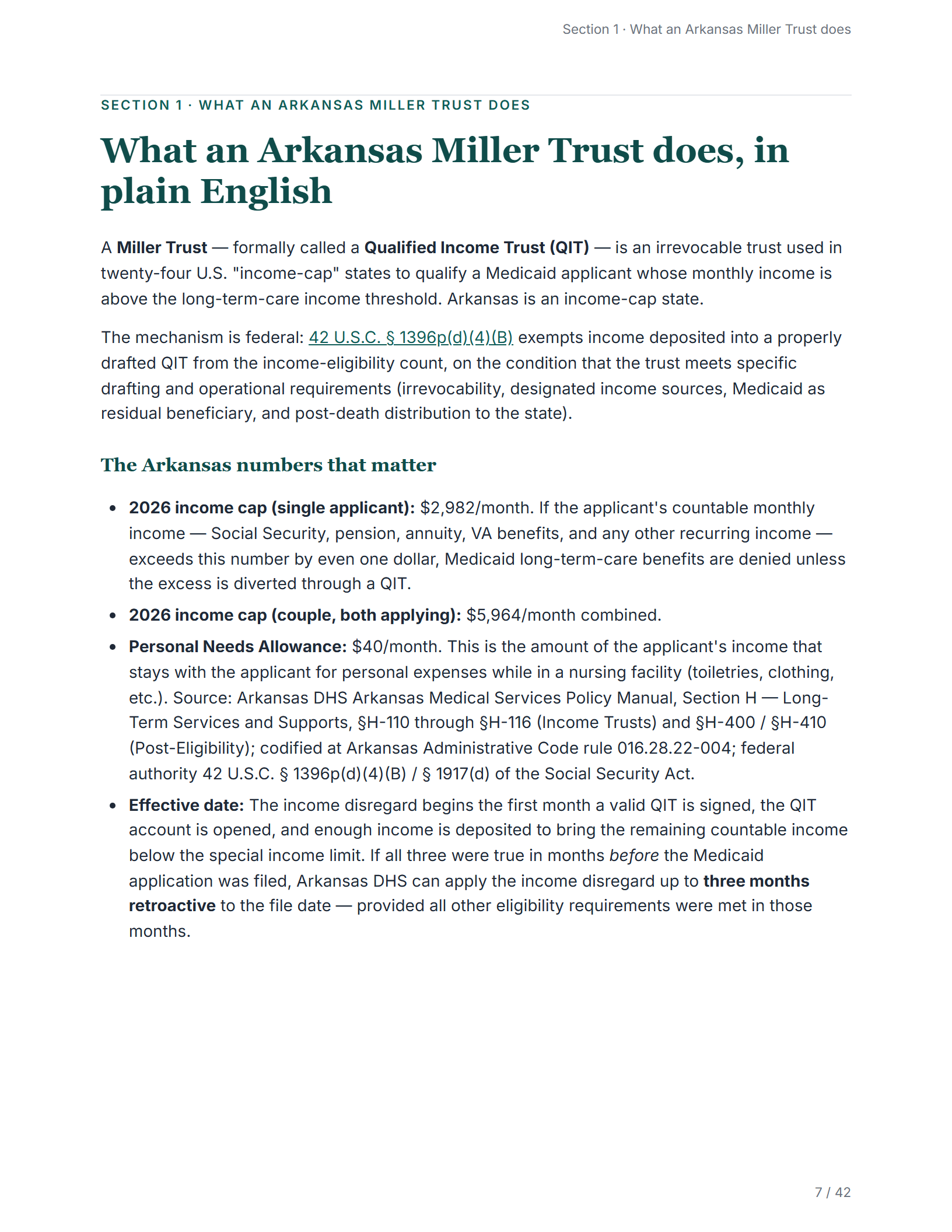
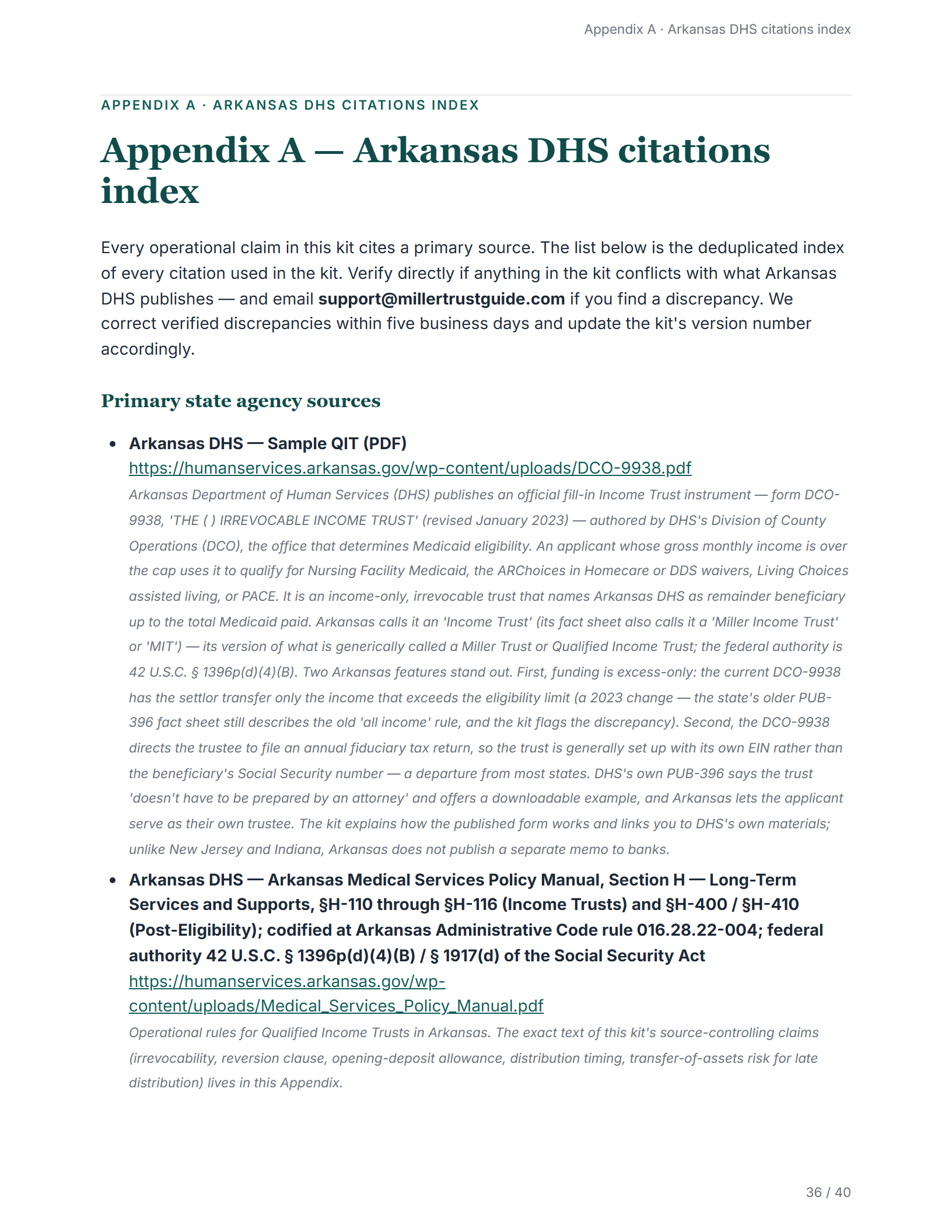
Print-friendly, readable on a phone or tablet, and designed to be taken to the bank. Every operational claim cites a primary state agency or federal source.
How this compares
Yes — Arkansas's own QIT form is free (that's the Free state PDF column below). The $97 is for everything the free PDF leaves you to work out alone: the bank step, the funding-month timing, and the denial traps.
| This kit | Elder-law attorney | Free state PDF | Doing nothing | |
|---|---|---|---|---|
| Cost | $97 | $1,000–2,500 | $0 | $0, then $7,148–$7,711/mo private-pay |
| Time to qualified | Same week | 2–6 weeks | If you can decode it alone | Not until you act |
| Bank-refusal script | Yes | Sometimes | No | n/a |
| State agency citations | Yes | n/a | n/a | n/a |
| Updated for 2026 income cap | Yes | Yes | If Arkansas has updated PDF | n/a |
| "What to say to family" script | Yes | No | No | n/a |
| Delivery time | Instant download | After consult + retainer | Instant | n/a |
Attorney costs reflect typical Arkansas elder-law retainers for a Miller Trust setup. Private-pay nursing-home figures reflect recent Arkansas market averages.
The bank step
The bank refusal nobody warns you about
You walk into your branch with the signed trust. The teller calls a manager. The manager has never seen one. They ask for an EIN. They tell you to come back with an attorney. You drive home with an empty trust account and a Medicaid clock ticking.
This is the single most common reason Arkansas families lose a month of benefits, and it has nothing to do with the trust itself — it is a bank-procedure problem. The kit's bank section gives you the exact language to cite at the counter, the Arkansas DHS policy reference to read aloud, and a printable resolution letter you can hand to the branch manager so they can escalate inside their own bank instead of sending you away.
Refusals the kit walks you through:
- Branch asks for a tax ID (EIN) for the trust.
- Branch is unsure what kind of account this is.
- Branch wants the applicant to be the account holder.
- Branch has never opened an income trust account.
Each refusal has a corresponding response in the kit, with the Arkansas DHS citation behind it.
The thing that saves a second trip: bring the printed Arkansas DHS policy page to the counter — not just the signed trust. A teller who can read the rule in black and white escalates in minutes; one who only has your word for it sends you home. The kit tells you exactly which page to print and hand across.
If Arkansas DHS rejects the trust, you pay nothing.
If the denial is for a reason traceable to following the kit, email the agency's stated denial reason to support@millertrustguide.com and we refund the full purchase price within one business day. Report it within 30 days of purchase if you can. If Arkansas DHS hasn't decided by then, email us anyway: the guarantee still applies once you have the denial. No phone tag, no forms, no fight. Changed your mind for any other reason? You have 7 days, no questions asked. We'd rather lose the sale than make this harder on a family already dealing with enough. Full refund policy.
Avoid these
The 9 most common Arkansas denial reasons
Every denial reason below cites Arkansas DHS policy. The full kit explains each one in context and the order in which to verify them before submitting the Medicaid application.
A resource (not income) is placed in the trust
Income and resources are commingled in the account
The over-cap income is not deposited in the month it is received
Another person's income is put in the trust
Missing State-of-Arkansas payback clause
The trust is revocable, or is modified without DHS agreement
Trying to fix an excess-resource problem with an income trust
A disbursement the caseworker did not authorize
The trust balance is allowed to accumulate past the limit
Before you go to the Arkansas bank
Most wasted trips are a bank-procedure problem, not a trust problem. This free one-pager has the questions to ask on the phone before you drive to a branch — emailed now. We'll also send 4 short follow-ups over the next 10 days (what the bank will ask, why denials are paperwork not eligibility, what other buyers found, when to call an attorney) — then we stop. No ongoing newsletter.
The author
Who's behind this
I'm James Whitfield. I built this kit to close the gap between the free state PDF and a funded Medicaid trust (the short version is up top). I'm not an attorney. I'm a researcher who has now read every Arkansas DHS policy section that covers Qualified Income Trusts, and I publish what I learned with a citation on every claim. I won't advise you on your specific situation, draft anything, or review a document you or your attorney have drafted; for advice on your situation, you need an Arkansas-licensed attorney.
Questions
Frequently asked questions
Is the Arkansas Income Trust Kit legal advice?
What does the kit include?
Do you provide the trust template itself?
Who has to set up an Income Trust in Arkansas?
Does an Arkansas Income Trust need an EIN?
How much of my income goes into the trust?
Is Social Security counted before or after the Medicare Part B premium for Arkansas's income limit?
What is the official order of monthly payments out of an Arkansas Income Trust?
Can I be my own trustee?
When does coverage begin?
What if my bank refuses to open the trust account?
What happens to the trust after the person on Medicaid passes away?
Do you offer a refund?
Will you talk to me on the phone about my situation?
Will Arkansas DHS accept an Income Trust I fill in myself?
Which banks will open a Qualified Income Trust (QIT) bank account in Arkansas?
Can you set up an Arkansas Miller Trust without a lawyer?
Can an attorney, paralegal, or care manager use this kit for a client?
Do I need a Miller Trust in Arkansas?
What if Arkansas DHS changes the form or the income cap after I buy?
Ready to start?
$97, one time. Instant download. Money-back if Arkansas DHS rejects your QIT for any reason traceable to following the kit, or for any other reason within 7 days.
No waiting room, no six-week retainer. The steps can be done in a few days. The usual holdup is the bank, and the kit covers what to say at the branch.
One last step — confirm below and it's instant from there.
Secure checkout by Stripe · Instant download · Money-back guarantee
One-time charge, no subscription. It shows on your card statement as MILLERTRUSTGUIDE.COM.
Want them to see the whole case? Send them what you just read.
Not ready to buy yet?
Free 5-email series: the funding-month rule, what really happens at the Arkansas bank, why most denials are paperwork not eligibility, who manages the trust each month, and the one honest sign it's time to call an attorney instead. Then we stop. No ongoing newsletter, no sales list.
Keep reading
Step-by-step Arkansas guides
New to this? What Is a Miller Trust? covers the plain-English basics — what it is, why states use different names for it, and how it differs from a Medicaid Asset Protection Trust. Below are the free operational walkthroughs that go deeper on the questions Arkansas families ask most.
Free operational walkthroughs
- How to Set Up an Income Trust in Arkansas: Step by Step
- How Long Does It Take to Set Up an Income Trust in Arkansas?
- How Much Does It Cost to Set Up an Income Trust in Arkansas?
- How Much Does a Nursing Home Cost in Arkansas?
- What to Say at the Bank When Opening an Income Trust Account in Arkansas
- Who Can Be the Trustee of an Income Trust in Arkansas?
- Do You Need an EIN for an Income Trust in Arkansas?
- What Happens to an Income Trust When the Beneficiary Dies in Arkansas?
Primary sources
State agency sources
Last verified against Arkansas DHS on September 9, 2026. Email support@millertrustguide.com if anything below conflicts with what Arkansas DHS currently publishes — we correct verified discrepancies within five business days.
Every claim here cites a primary Arkansas DHS or federal document — see them
Primary state agency sources
- Official template: Arkansas DHS — Arkansas Medical Services Policy Manual, Section H — Long-Term Services and Supports, §H-110 through §H-116 (Income Trusts) and §H-400 / §H-410 / §H-412 (Post-Eligibility, incl. the numbered nursing-facility and assisted-living deduction sequences); codified at Arkansas Administrative Code rule 016.28.22-004; federal authority 42 U.S.C. § 1396p(d)(4)(B) / § 1917(d) of the Social Security Act. Note: §H-111's own 'all income must be placed in the trust' text is itself stale (last stamped 07/13/15) and, like the older PUB-396 fact sheet, conflicts with the current (Jan. 2023) DCO-9938 form's excess-only funding language — this guide follows the current form, not the un-updated manual passage. . Arkansas Department of Human Services (DHS) publishes an official fill-in Income Trust instrument — form DCO-9938, 'THE ( ) IRREVOCABLE INCOME TRUST' (revised January 2023) — authored by DHS's Division of County Operations (DCO), the office that determines Medicaid eligibility. An applicant whose gross monthly income is over the cap uses it to qualify for Nursing Facility Medicaid, the ARChoices in Homecare or DDS waivers, Living Choices assisted living, or PACE. It is an income-only, irrevocable trust that names Arkansas DHS as remainder beneficiary up to the total Medicaid paid. Arkansas calls it an 'Income Trust' (its fact sheet also calls it a 'Miller Income Trust' or 'MIT') — its version of what is generically called a Miller Trust or Qualified Income Trust; the federal authority is 42 U.S.C. § 1396p(d)(4)(B). Two Arkansas features stand out. First, funding is excess-only: the current DCO-9938 has the settlor transfer only the income that exceeds the eligibility limit (a 2023 change — the state's older PUB-396 fact sheet still describes the old 'all income' rule, and the kit flags the discrepancy). Second, the DCO-9938 directs the trustee to file an annual fiduciary tax return, so the trust is generally set up with its own EIN rather than the beneficiary's Social Security number — a departure from most states. DHS's own PUB-396 says the trust 'doesn't have to be prepared by an attorney' and offers a downloadable example, and Arkansas lets the applicant serve as their own trustee. The kit explains how the published form works and links you to DHS's own materials; unlike New Jersey and Indiana, Arkansas does not publish a separate memo to banks.
- [1] Policy manual: Arkansas DHS policy manual (section Arkansas Medical Services Policy Manual, Section H — Long-Term Services and Supports, §H-110 through §H-116 (Income Trusts) and §H-400 / §H-410 / §H-412 (Post-Eligibility, incl. the numbered nursing-facility and assisted-living deduction sequences); codified at Arkansas Administrative Code rule 016.28.22-004; federal authority 42 U.S.C. § 1396p(d)(4)(B) / § 1917(d) of the Social Security Act. Note: §H-111's own 'all income must be placed in the trust' text is itself stale (last stamped 07/13/15) and, like the older PUB-396 fact sheet, conflicts with the current (Jan. 2023) DCO-9938 form's excess-only funding language — this guide follows the current form, not the un-updated manual passage.).
- PUB-396 — Income Trust Fact Sheet: Arkansas DHS — PUB-396 — Income Trust Fact Sheet . DHS's plain-language guide to establishing and maintaining an Income Trust — definitions, the single income-only account rule, trustee responsibilities, and the DHS-712 monthly-disbursement worksheet. Note: this fact sheet (rev. 05/18) predates the 2023 DCO-9938 and still describes the old 'all income' funding rule; follow the current DCO-9938 (excess-only) and this kit for funding.
- PUB-125 — Long-Term Services and Supports (LTSS) Information: Arkansas DHS — PUB-125 — Long-Term Services and Supports (LTSS) Information . DHS's overview of the LTSS programs (Nursing Facility, ARChoices, Living Choices, DDS Waiver, PACE) and the shared income and resource limits — it states the income limit is three times the SSI Standard Payment Amount and that income over the limit is handled through an Income Trust.
Federal sources
- 42 U.S.C. § 1396p(d)(4)(B) — federal Medicaid statute authorizing QITs. https://www.law.cornell.edu/uscode/text/42/1396p
- CMS — 2026 SSI and Spousal Impoverishment Standards. https://www.medicaid.gov/federal-policy-guidance/downloads/cib12092025.pdf . Source for the 2026 Federal Benefit Rate and the 300% cap derivation used in the Arkansas income-cap figure.
- SSA — 2026 SSI Federal Payment Amounts. https://www.ssa.gov/oact/cola/SSI.html . Verification of the 2026 FBR figure CMS uses to compute the 300% Medicaid long-term-care income cap.