The process, step by step
How to Set Up a Miller Trust (Qualified Income Trust)
Six steps: confirm you need one, get your state's own trust document, name a trustee and sign it, open a dedicated bank account titled to the trust, fund it, and submit it to Medicaid. The detail every state shares and most families miss: the trust has to be signed, funded, and holding enough income to drop under the cap within the same calendar month coverage should start — nothing is back-dated, so a delay of even a few days can cost a full month of eligibility.
Key figures
- Attorney cost, if you hire one
- $1,000–$2,500
- Funding deadline
- Same calendar month
- States with their own fill-in form
- 11 of 25 live states
- States requiring attorney drafting
- 14 of 25 live states
Before you start
This page assumes you already know what a Miller Trust is and that your state uses one — if not, start with What Is a Miller Trust? first, which covers the definition, which states require one, and how it differs from a Medicaid Asset Protection Trust. What follows is the general shape of the setup process that holds across states; the specifics underneath — the exact form, income cap, and submission process — vary by state, and each state guide on this site covers those directly.
The six steps
-
Confirm you actually need one
Check whether your state is an income-cap state (most are) and whether the applicant's gross monthly income is actually over that state's Medicaid long-term-care limit — a Miller Trust only matters if both are true. A few states don't use this mechanism at all, and a couple use it only for a specific waiver, not nursing-facility Medicaid.
-
Get your state's own trust document
Where your state publishes an official fill-in Qualified Income Trust form (11 of the 25 states live on this site do), that form is the starting document. Where it doesn't (14 states), an attorney drafts one to meet that state's own published requirements instead — either way, the trust has to satisfy your specific state's rules, not a generic template found online.
-
Name a trustee and sign the trust
Most states require someone other than the applicant to serve as trustee — the person who will manage the account and make the required monthly distributions. The trust becomes the legal instrument once it's properly signed; some states also require it to be notarized.
-
Open a dedicated bank account titled to the trust
The account is titled in the trust's name, with the trustee — not the applicant — as the authorized signer. Expect the first bank branch to hesitate; most branches have never opened this account type before, and asking for the trust department (rather than a general teller) usually moves things along faster.
-
Fund the trust that same calendar month
This is the step families most often get wrong: the trust generally has to be signed, have a funded account, and receive enough of the applicant's income to drop countable income under the cap — all within the same calendar month. Nothing is back-dated, so a trust finished on the 3rd of a month can start that month's eligibility; one finished on the 1st of the next month cannot reach back and cover the month before.
-
Submit it to your state's Medicaid agency and keep proof
Submit the signed trust and account documentation with the Medicaid application (or as a supplement to a pending one), and keep copies of everything — the signed trust, the account opening paperwork, and the first deposit record. That paper trail is what resolves a denial or a request for more information quickly.
The funding-month rule
- September Trust not funded Private-pay bills for the whole month.
- October Sign, open, deposit Trust signed, account opened and income deposited, all this month. Eligible from October.
- November onward Deposit every month The income goes into the trust account every month to keep eligibility.
The trust can't be back-dated. Funding in October can't cover September.
A note on Florida and Kentucky
The self-directed version of this process — completing a state form yourself — doesn't apply in Florida or Kentucky. Florida's Supreme Court has issued an advisory opinion specifically naming Qualified Income Trust forms or kits as something a nonlawyer shouldn't sell; Kentucky follows the same stricter posture as a precaution. In both states, this site limits itself to explaining the legal requirements in plain language — see the Florida guide and Kentucky guide for what that looks like there.
What it costs either way
An elder-law attorney typically charges $1,000–$2,500 to handle a Miller Trust from research through drafting. Where a state publishes its own fill-in form, the core setup — completing that form and opening the bank account — is a paperwork-and-banking task many families handle themselves without an attorney. Where no fill-in form exists, an attorney typically drafts the trust regardless, since it has to satisfy the state's published requirements exactly. Each state guide on this site is built around whichever situation applies to that state, so the cost comparison is specific rather than generic.
Official fill-in form (11 states)
- Who writes the trust
- You, using the state's own free form.
- What an attorney typically charges
- $1,000–$2,500 if you hire one. Many families handle the core setup themselves.
- What a $97 state guide adds
- The process around the form: a funding worksheet, the bank-refusal script, and the reasons the agency denies these.
An attorney drafts the trust (14 states)
- Who writes the trust
- An attorney, to the agency's published requirements.
- What an attorney typically charges
- $1,000–$2,500 for research plus drafting.
- What a $97 state guide adds
- The requirements checklist plus the funding and bank steps, so the attorney's time goes to drafting. In Florida and Kentucky, a plain-language explanation of the requirements only.
Skip the research, start with your state
Each state guide on this site ($97, instant download, where a kit is sold) walks through these six steps using your state's own official process — the exact form or requirements checklist, the bank-refusal script, and the most common reasons that state's Medicaid agency rejects a trust — backed by a money-back guarantee if your state rejects it for a reason traceable to following the guide.
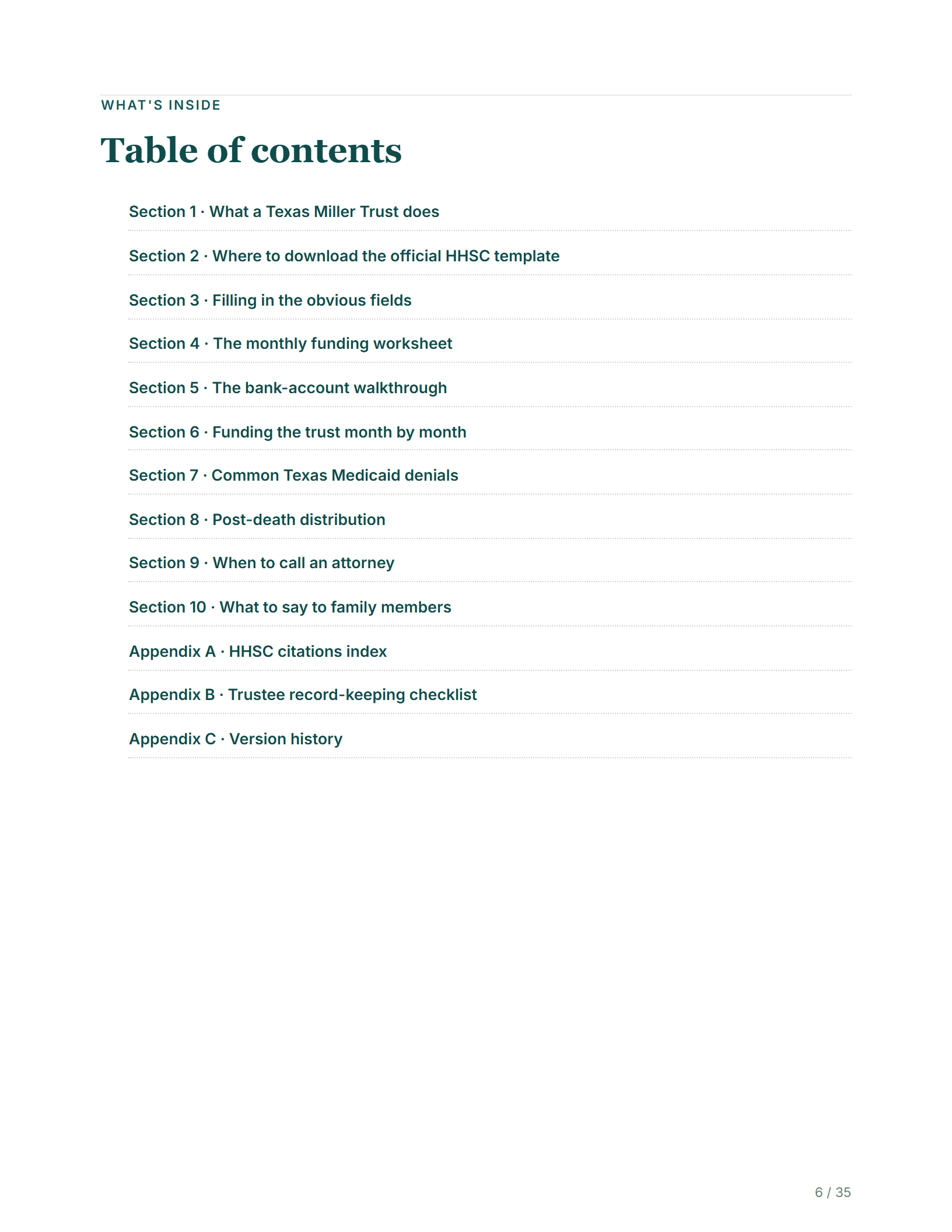
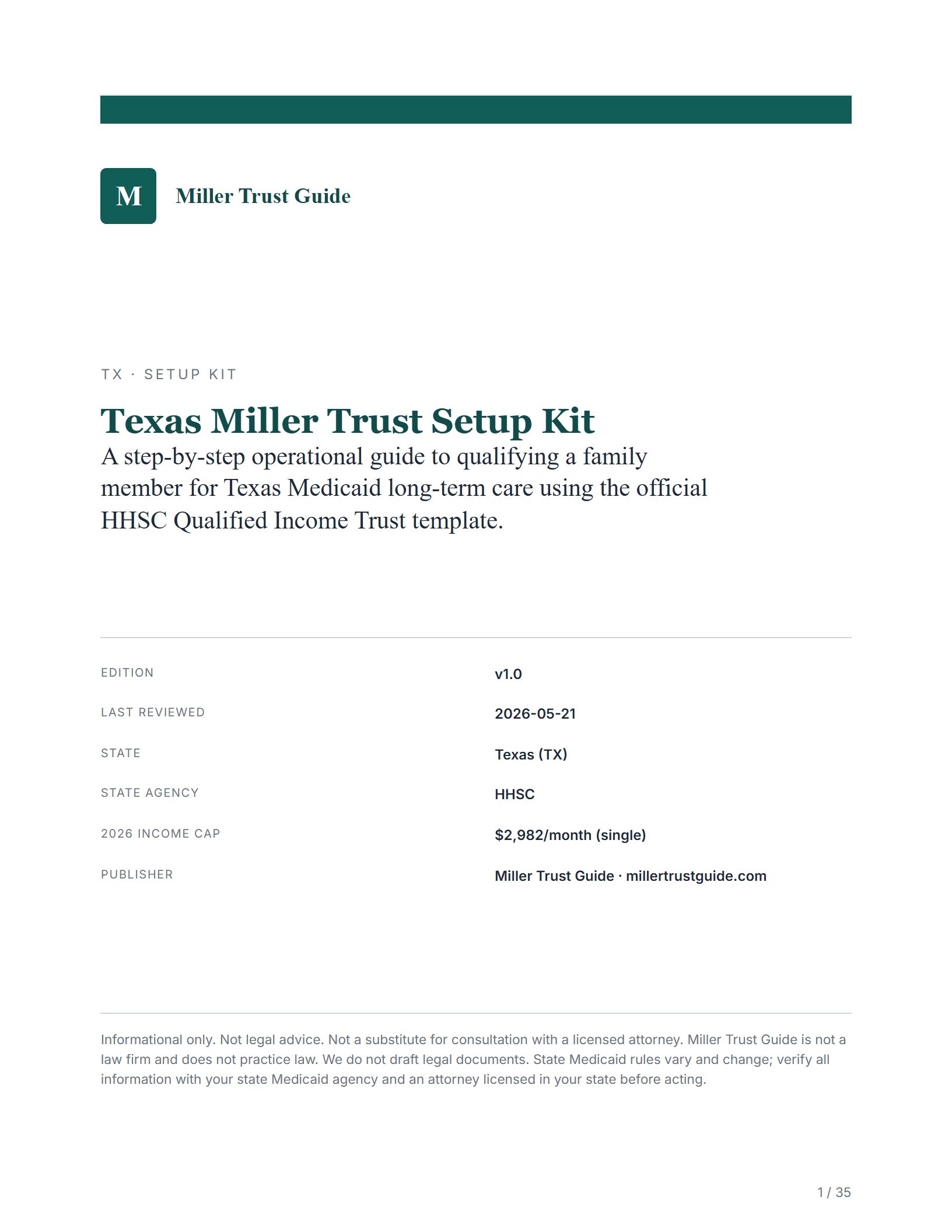
Shown: the cover and contents of the Texas kit.
- Built on each state's own published Medicaid policy
- Every claim cited to the state agency's policy
- Secure checkout by Stripe
- Money-back if the trust is rejected
If your state's Medicaid agency rejects the trust, you pay nothing.
If the denial is for a reason traceable to following the guide, email the agency's stated denial reason to support@millertrustguide.com and we refund the full purchase price within one business day. Report it within 30 days of purchase if you can. If your state's Medicaid agency hasn't decided by then, email us anyway: the guarantee still applies once you have the denial. No phone tag, no forms, no fight. Changed your mind for any other reason? You have 7 days, no questions asked. We'd rather lose the sale than make this harder on a family already dealing with enough. Full refund policy.
The mistakes that cost families a month of Medicaid coverage
5 short, plain-English emails over 10 days — the funding-month rule, what really happens at the bank, why denials are paperwork not eligibility, what a retired attorney and CPA wrote after using a kit, and the honest signs it's time to call an attorney instead. Then we stop. No ongoing newsletter, no sales list.